

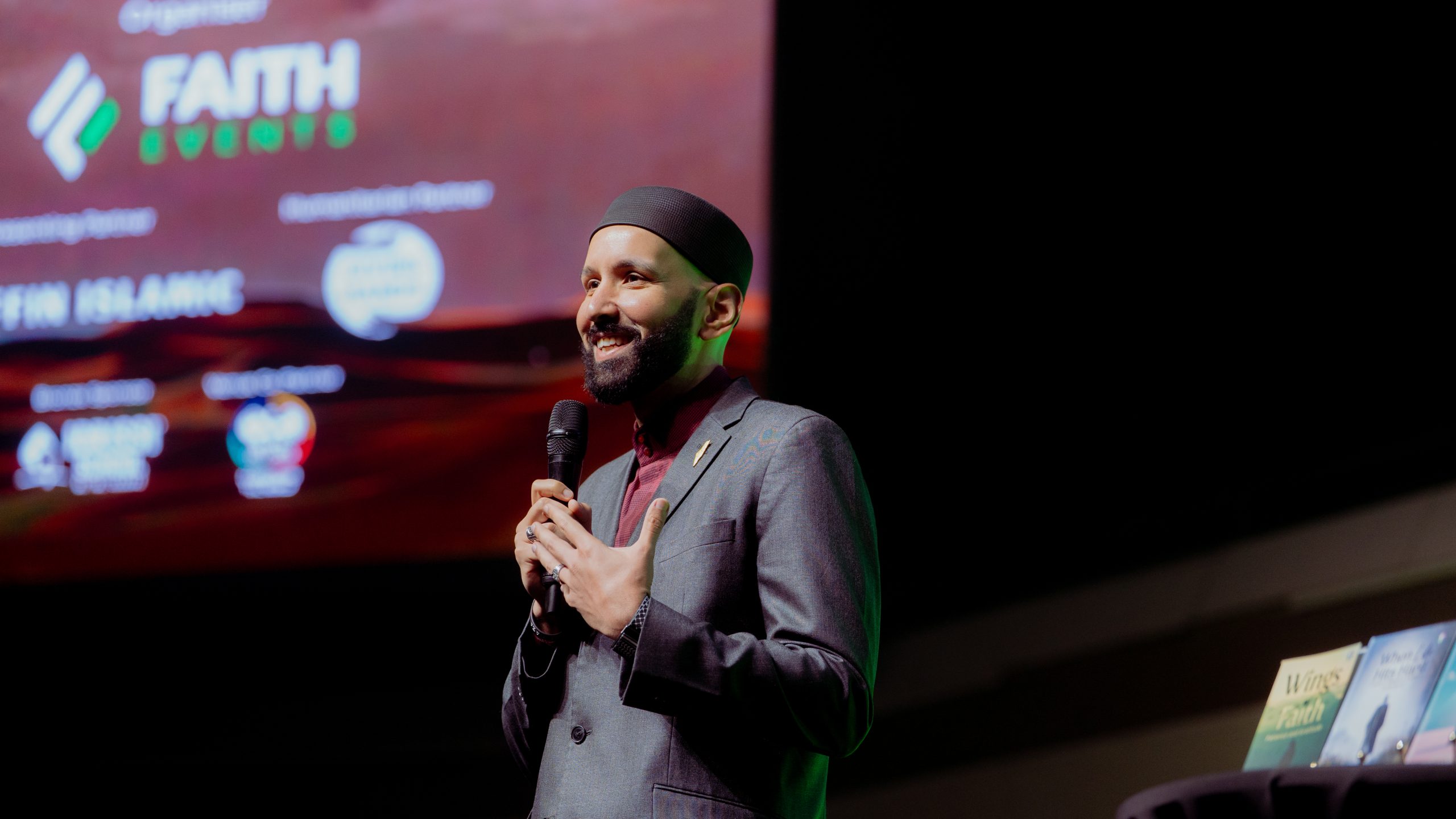
Some events you attend. Others, you carry home with you. For “Omar Suleiman Live in Malaysia”, it’s the second one.
Over two days, Dr. Omar Suleiman took us through two very different but deeply connected journeys— one through the story of the Family of ‘Imran, and another through the emotional landscape of Surah Al-Insan. Here’s a look back at what we took home from both.
The Seerah of What Feels Impossible—The Family of ‘Imran (a.s.).
Why does Allah (s.w.t.) highlight one particular family out of every family in human history? That was the question that opened the day. And the answer unfolded slowly, through people who lived ordinary, low-profile lives— and still became chosen.
‘Imran (a.s.) wasn’t a king or a warrior. He was, by his own community’s account, simply beloved. A man of character, a servant of Allah (s.w.t.) as he should be. His wife, Hannah, made a du’a’ before her child was even born, praying that the child would be free, dedicated entirely to serving Allah (s.w.t.). She didn’t yet know that ‘Imran (a.s.) would pass away before the birth, or that she’d become a widow while still expecting. She didn’t know her child would be a daughter in a community that forbade women from entering the masjid. And still, her du’a’ held.
That child was Maryam (a.s.). And the way her guardian, Zakariya (a.s.), responded to a rule that would have kept her from worship by building her a private mihrab so she could still serve Allah (s.w.t.) in a quiet kind of devotion that doesn’t ask for recognition.
Zakariya’s (a.s.) own story became one of the most moving threads of the day. Well into old age, still making du’a’ for a child, still holding onto hope in what looked impossible. When the answer finally came—a son named Yahya, a name never given before—he wasn’t questioning Allah’s (s.w.t.) ability. He was simply asking, what happens next? And when the good news arrived, the first thing he did was prostrate himself in gratitude.
Here are a few reminders from this session that are worth sitting with:
- We don’t need perfect circumstances to worship Allah (s.w.t.).
- Some of the greatest legacies start with a single, sincere du’a’.
- Not every good deed needs to be witnessed.
- True success isn’t comfort or recognition. It’s sincerity, steadfastness, and staying devoted even when the world is against you and your faith.
A Life Worth Meeting Allah (s.w.t.) With—Surah Al-Insan
“What am I actually doing with the time I’ve been given?”
Surah Al-Insan doesn’t let you look away from that question. Dr. Omar Suleiman walked through it in a way that felt less like a lecture and more like an honest audit: how many hours of our lives go to nonsense? How much of our wealth is earned and spent without a second thought about where it came from? How easily do we curse a bad day, without realising we’re really cursing the One who controls time itself?
One of the most humbling reminders of the day: Allah (s.w.t.) doesn’t need us. The world would carry on if any one of us disappeared from it. That’s not a bleak thought; it’s actually freeing. Because once you stop needing to be needed, you stop performing, and you can finally just serve.
A few reflections that stayed with us long after the session ended:
- Ego is one of the biggest barriers between us and Allah (s.w.t.).
- What you give up for Allah (s.w.t.) in this dunya, is never really lost. Instead, you’re promised something far better in return.
- Good deeds are best kept quiet.
- Gratitude is more than a word. It’s recognising that everything we have was never really ours to begin with.
To Everyone Who Joined Us
Across both days, the Tertib Publishing booth was full of familiar faces, new readers, and so many meaningful conversations. To everyone who stopped by, browsed, or brought a book home with them—thank you. Your support means more than we can put into words.

